Running a rental business means keeping a lot of moving pieces under control at the same time. Equipment is going out, coming back, moving between branches, waiting for service, and being reserved for the next customer. At the same time, invoices need to go out, payments need to come in, and maintenance cannot fall behind. A missed reservation, a forgotten accessory, or a repair that never gets recorded can quickly turn into an expensive problem.
That is where business rental software makes a practical difference. Instead of relying on paper contracts, whiteboards, spreadsheets, and separate accounting tools, rental companies can manage reservations, inventory, inspections, maintenance, billing, and customer activity from one connected system. The goal is simple: keep more of your equipment working, reduce avoidable mistakes, and give your team a clearer picture of what is happening across the business.
Whether you run an equipment yard, tool rental store, event rental company, or industrial fleet, the right rental platform can take a large amount of routine work off your team’s plate. Below, we look at the areas where modern rental software can have the biggest impact.
What Is Business Rental Software and How Does It Work?
Business rental software is built around a basic difference between selling an item and renting one: the item does not leave your inventory permanently. Its status changes throughout its useful life. It may be available today, reserved for Friday, out with a customer next week, sitting in the service shop, or waiting for inspection after a return.
A rental system keeps those changes connected. An equipment record can include its current location, meter readings, service history, upcoming reservations, inspection details, and other information your staff needs before putting it back on rent. That gives counter staff and yard teams a shared view instead of forcing each department to maintain its own version of the truth.
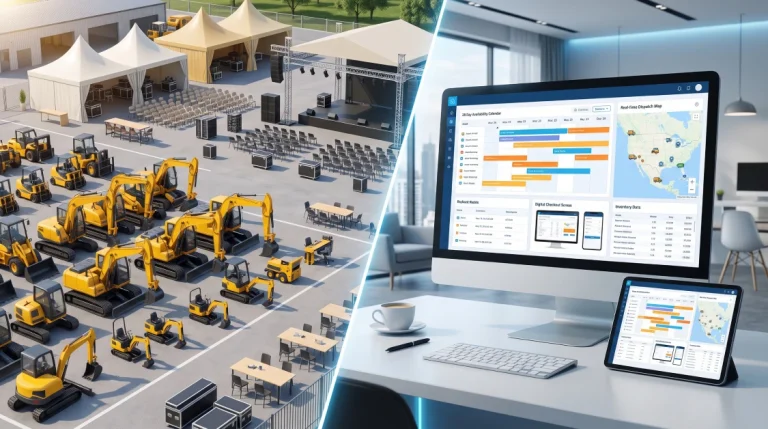
Scheduling is another important part of the picture. A dedicated rental platform can connect contracts, rates, delivery requirements, and availability so staff can see conflicts before they become customer problems. For example, integraRental provides a 28-day visual asset view that helps teams see upcoming availability across branches. When an item is returned or moved into a repair status, the change can be reflected across the system rather than waiting for someone to update several separate records.
To see how this approach can fit different rental operations, explore our rental software solutions.
How Does Rental Software Adapt to Different Industries?
Not every rental business manages equipment in the same way. A construction yard may need serial numbers and engine-hour tracking, while an event company may need to count hundreds of chairs or manage a sound-system package made up of dozens of smaller pieces. Industrial fleets may have additional inspection and compliance requirements.
A useful rental platform accounts for those differences instead of forcing every business into the same workflow.
| Rental Industry | Common Needs | Useful Workflows |
| Heavy Machinery & Tool Yards | Serialized assets, meter readings, preventive service | Runtime alerts, dispatch planning, rate tiers |
| Party, AV & Event Staging | Kits, bulk inventory, weekend scheduling | Parent-child bundles, buffer scheduling, quantity tracking |
| Oil, Gas & Industrial Sites | Remote tracking, safety records, compliance | Geofencing, telematics, automated work orders |
Heavy Equipment Yards and Tool Rental Stores
Equipment dealers and tool rental stores need to know exactly what is available, where it is, how long it has been running, and when it needs service. A rental system can use meter readings or calendar intervals to trigger maintenance reminders. That helps the shop get ahead of problems instead of waiting for a machine to fail on a customer’s jobsite.
Party, Audio-Visual, and Production Rentals
Event and party rental operations have a different challenge: one booking can include a large number of related items. A tent may need stakes, sidewalls, and other accessories. A sound system may require microphones, cables, stands, and power equipment. Rental software can keep those items together as a kit so the warehouse team is less likely to miss a small but essential component.
For wedding, party, and production workflows, see our party and event rental software.
Energy and Heavy Industrial Fleets
Oilfield pumps, generators, and other industrial equipment can spend time in remote locations, where keeping track of condition and compliance is especially important. Specialized oil and gas equipment rental software can give operations teams a better view of equipment in remote yards, drilling locations, and other field environments.
To compare workflows across different markets, browse our industry rental software options.
Why Are QuickBooks and ERP Integrations So Important?
Accounting becomes harder when rental activity and financial records live in separate systems. Rental invoices can include deposits, different rental periods, meter overages, damage charges, fuel fees, and adjustments after an item comes back. Re-entering all of that information manually creates more opportunities for errors.
With a direct QuickBooks connection, invoices, payments, service charges, and other transactions can move between the rental system and the accounting system without staff typing the same information twice. That saves time and makes it easier for management to see what has been billed, what has been collected, and where money is tied up.
For larger rental companies, integraRental can connect with integraERP to bring rental operations, warehouse distribution, procurement, and the general ledger together in one environment.
How Do Telematics, Payments, and Market Data Protect Margins?
Rental margins can disappear in small places: equipment that cannot be located, hours that were never billed, deposits that take too long to collect, or rates that are too low for a busy market. Integrations help close some of those gaps by connecting the rental system to the tools your team already relies on.
| Integration | Technology | Business Benefit |
| GPS Telematics | SolarTrak | Live location, geofencing, runtime capture |
| Payments | Fortis | Cards on file, recurring billing, faster checkout |
| Market Intelligence | Rouse Analytics | Regional rate benchmarks and fleet insights |
GPS Telematics and Fleet Tracking
Lost equipment and missed meter charges can add up quickly. With SolarTrak telematics, rental operators can see where equipment is located, capture engine runtime, and use geofence alerts to flag unexpected movement.
Integrated Payment Processing
Deposits and recurring charges should not require a separate manual process every time. Fortis payment processing can support tokenized cards on file, recurring billing, and counter-based payments while keeping the payment workflow connected to rental activity.
Industry Market Intelligence
Pricing decisions are easier when they are based on current market information rather than guesswork. Rouse Analytics can provide rental market benchmarks that help teams review rates, fleet performance, and asset values.
See the complete software integrations library for additional connections.
How Do Mobile Apps and eRental Storefronts Improve Field Efficiency?
Rental work does not stop when someone leaves the counter. Drivers need to document deliveries, mechanics need to record service work, and customers increasingly expect to check availability without calling the rental office. Mobile tools and online storefronts bring those activities into the same workflow.
Digital jobsite inspections: Drivers can take time-stamped photos, record equipment condition, capture fuel and meter readings, and collect customer signatures from a mobile device.
Driver’s license scanning: ID scanning can pull customer information into an account quickly, reducing manual typing at the counter.
24/7 eRental storefronts: Customers can check live availability, see applicable rates, and send reservation requests online instead of waiting for business hours.
Fleet dispatching: Dispatch teams can review daily deliveries, assign routes, use Google Maps, and apply transportation-zone charges more consistently.
To improve the online side of your rental operation, explore our rental web design and digital marketing services.
How Does Preventive Maintenance Improve Rental ROI?
Maintenance is not just a shop issue. When a machine fails in the middle of a customer’s project, the rental company may have to arrange an emergency repair, send a replacement, issue a credit, or deal with a frustrated customer. Keeping service work organized helps reduce those avoidable costs and keeps equipment earning revenue.
A typical rental maintenance workflow can look like this:
- Check-in inspection: When equipment returns, the yard team records its condition, meter reading, and fuel level.
- Maintenance status: If an item is damaged or reaches a service threshold, it is moved out of available inventory so it cannot be booked accidentally.
- Service work order: The system creates or records the work required, including parts, labor, and inspection steps.
- Return to ready: Once the work is complete, technicians record what was done and the equipment is released back into rental inventory.
For deeper asset history, depreciation, and lifecycle tracking, see our asset management solutions.
Frequently Asked Questions
What features should small equipment rental businesses look for?
Look for real-time inventory visibility, QuickBooks synchronization, mobile check-in and check-out, preventive maintenance scheduling, and digital contracts. The most useful system is one that removes repetitive work without making everyday counter operations harder.
How can rental software handle both serialized equipment and bulk inventory?
Serialized equipment can be tracked by individual equipment ID, including meter readings, service history, and location. Bulk items such as chairs, linens, or cables can be managed by quantity across reservation dates, helping the system show how many units are actually available.
Can rental software integrate with QuickBooks Online and Desktop?
Yes. Platforms such as integraRental can connect with QuickBooks Online and QuickBooks Desktop so rental invoices, service charges, and other transactions can be synchronized with customer and accounting records.
How do GPS integrations help with theft prevention and billing?
GPS integrations such as SolarTrak and RoviTracker can provide live equipment locations and actual engine-hour readings. Geofence alerts can help flag unexpected movement, while runtime data can support more accurate billing when contracts include excess-hour charges.
What is the benefit of a 24/7 eRental storefront?
An eRental storefront connects the customer-facing website with live rental inventory. Customers can check availability, review pricing, and submit booking requests outside normal office hours. For rental teams, it can also reduce repetitive calls about basic availability and pricing.