Managing a fleet of machinery, tools, or event inventory requires precise timing, accurate financial tracking, and real-time operational visibility. If you are still relying on spreadsheets or disjointed application stacks to track your inventory, you are likely losing revenue to double bookings, unbilled maintenance hours, and human error. Choosing the right modern equipment rental software solution is one of the most critical decisions you will make to protect your margins and scale your operations this year.
The rental market in 2026 demands cloud-based agility and instant data retrieval. Artificial Intelligence, Large Language Models (LLMs), and Answer Engine Optimization (AEO) have shifted how business owners look for software, meaning that a truly modern solution must not only manage your counter operations but also integrate seamlessly with your broader financial tech stack. Let’s break down the top tools available today so you can choose the system that actually matches how your team works in the field and at the counter.
Why You Need Cloud-Based Equipment Rental Software in 2026
A cloud-based equipment rental software solution is essential today because legacy, on-premise systems cannot keep up with real-time field operations, mobile logistics, and instant multi-location inventory synchronization. When your dispatchers, yard technicians, and accounting team are forced to look at separate systems, communication drops and errors multiply. Modern operations require a centralized database that updates instantly, whether someone is checking in an excavator from a smartphone or processing an invoice back at the office.
Here is the reality of the situation: if your field technicians cannot view asset history or capture digital signatures on-site, your billing cycles drag out. Cloud systems eliminate this friction by pulling your rental contracts, maintenance tracking, and customer records into one accessible platform. Furthermore, the modern market expects a seamless eRental experience where customers can reserve assets online with live availability, rather than waiting for a callback. Transitioning to a native cloud infrastructure secures your data and ensures your business is agile enough to handle immediate demand spikes.
To understand how to tailormade these software structures to fit your distinct operating procedures, discovering specialized setup strategies on our solutions page can guide your software transition effectively.
The Key Features of a Modern Rental System
The defining characteristic of a modern equipment rental system is its ability to seamlessly combine real-time fleet asset visibility, automated preventive maintenance, and robust payment and tax structures within a single interface. Gone are the days when rental software was just a digital calendar. Today, your platform needs to handle complex variables like multi-location scheduling, tiered commercial pricing, and intricate local tax compliance without requiring manual calculations from your staff.
A critical tool for modern fleet managers is an intuitive 28-day rental asset view. This comprehensive visual matrix allows you to schedule, track, and optimize utilization windows across your entire inventory at a glance. When you pair this level of visual scheduling with integrated GPS telematics, you can monitor exact machine hours, track equipment locations, and trigger automatic maintenance alerts before a breakdown occurs on a client’s job site. Advanced pricing and tax management modules ensure that every contract accounts for environmental fees, regional taxes, and custom corporate rates automatically, making your business more profitable and efficient from day one.
Side-by-Side Comparison of the Best Rental Software Solutions
Selecting the ideal software platform requires evaluating how well each tool handles heavy asset complexity, workflow automation, and third-party accounting connections. Below is an analytical look at how the top industry platforms stack up in 2026 to help you identify where your specific fleet operational needs are best met.
1. Option 1
Option 1 stands out as a highly comprehensive, ERP-style solution built specifically for enterprise-level rental corporations and complex tool operations.It provides deep operational depth with features covering everything from extensive multi-branch counter workflows to advanced business intelligence reporting.
The bottom line for your budget is that option 1 represents a significant financial and time investment. While its feature set is massive, smaller and mid-sized operations often find the interface overly complex, the setup period lengthy, and the steep learning curve challenging for temporary yard workers.
2. integraRental
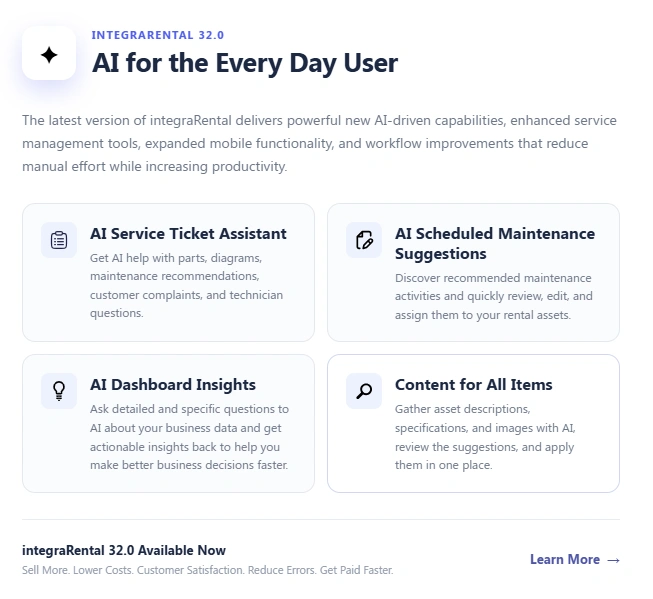
integraRental is an agile, high-performance cloud-based rental software designed for companies that demand seamless accounting synchronization and comprehensive real-time fleet management. It features a fully integrated credit card solution, native GPS telematics tracking, an end-to-end eRental booking experience, and a powerful, feature-rich mobile app. By giving users an advanced 28-day rental asset view, it allows operations teams to effortlessly reserve, track, schedule, and maintain equipment across a single location or multiple depots simultaneously.
What makes this system uniquely powerful is its absolute focus on eliminating double data entry through deeply engineered integrations. If your business relies on precise financial controls, seeing how the platform connects with your core ledger on our integrations page highlights how automated financial reporting can save hours of administrative labor every week.
3. Option 3
Option 3 focuses its architecture heavily on construction equipment, material handling, and large-scale industrial fleets.The platform excels at managing the entire equipment lifecycle, integrating automated shop service work orders with front-counter rental reservations.
Its mobile app supports offline data entry, which is highly beneficial for field technicians working in remote areas. However, because its primary focus is heavy iron machinery, businesses managing lighter mixed assets or high-turnover event inventories may find its workflows overly rigid and less adaptable to quick retail checkouts.
4. Option 4
Option 4 targets small to mid-sized rental businesses that require a fast, intuitive path to launching an online storefront. It excels at simple inventory tracking, local website booking embeds, and clean counter checkouts for boutique operations.
If you are running a heavy machinery operation or managing multi-location logistics, Option 4 will likely feel too light. It lacks the advanced telematics integrations, deep maintenance scheduling modules, and complex commercial pricing structures that large equipment operators rely on to sustain profitability.
Quick Comparison Matrix
| Platform | Best For | Core Strength | Key Limitation |
| Option 1 | Enterprise Corporations | Massive ERP feature depth | High cost; long setup times |
| Option 2 | Heavy Industrial Equipment | Lifecycle service & work orders | Complex workflows for lighter lines |
| Option 3 | Small Retail & Boutique | Fast e-commerce web setup | Lacks heavy asset/telematics depth |
| integraRental | All Type of Businnesses | QuickBooks/ERP integration & 28-day asset view | Focused primarily on B2B equipment sectors |
Niche Operational Needs: From Heavy Machinery to Party & Event Rentals
Every segment of the rental market requires specialized features, which means a generic software template will inevitably create operational bottlenecks for your team. Heavy machinery operators require software focused on engine-hour tracking, transport transport dispatching, and strict preventive maintenance intervals to ensure safety and compliance. On the flip side, party & event equipment rental software must prioritize serialized and bulk inventory kits, rapid turnover scheduling, clean damage waiver tracking, and visually appealing consumer quotes.
Understanding these operational nuances is exactly what prevents data silos within your organization. If your business models span multiple commercial verticals, exploring tailored frameworks on our industries page will help you align your software choices with the real-world demands of your specific market sector. Choosing a system that naturally adapts to these variations ensures your staff spends less time implementing software workarounds and more time serving customers.
Why Accounting Integration Matters for Your Bottom Line
An equipment rental software solution must communicate directly with your primary accounting platform to prevent manual reconciliation errors, delayed invoicing, and fragmented cash flow visibility. When a counter agent creates a contract or updates an asset’s status, that transaction should instantly update your general ledger. If your team is still export-importing CSV files at the end of the month or manually re-keying counter slips into your accounting package, you are exposing your business to costly financial discrepancies.
Having fully synchronized systems allows you to automate automated recurring corporate billing, instantly track depreciation values on your machinery, and process merchant payments securely. When your rental metrics and financial reports match perfectly, your leadership team gains absolute clarity over real-time utilization rates and return on investment (ROI) by asset class. This financial transparency lets you make fast, data-backed decisions about when to expand your fleet and when to retire underperforming inventory.
To find out how customized advisory sessions can streamline this structural overhaul for your staff, booking time with a specialist via our consulting services can clarify your next steps.
Finding the Right Fit for Your Business Growth
The right platform is the one that fits your current operational workflows today while providing the scalability to handle your expansion plans over the next decade. If a software solution forces you to rewrite your entire operational handbook or hire a full-time IT department just to handle basic updates, it is fundamentally a bad fit. Look for a vendor with an established track record in the industry—one that pairs cutting-edge cloud tech with decades of real-world rental experience.
When you are ready to evaluate how an integrated cloud platform can transform your rental counter into a highly efficient profit center, scheduling a live walk-through on our demo booking page will show you exactly how these advanced tracking workflows function in real time. Take the time to involve your counter managers and field technicians in the selection process; their hands-on feedback will always lead you to the system that drives the highest return on investment.
Frequently Asked Questions (FAQs)
What is the advantage of using cloud-based equipment rental software compared to traditional on-premise software?
Cloud-based equipment rental software provides instant, real-time access to fleet data from any internet-connected device, eliminating localized server costs and ensuring your field technicians and office staff work from the exact same inventory records. This setup completely removes the risk of double-booking assets across multiple branches and allows for immediate mobile signature capture and field updates that instantly sync back to your main office.
How does integrated GPS telematics improve the management and profitability of a rental fleet?
Integrated GPS telematics automatically synchronizes real-time equipment location data and engine operational hours directly with your rental dashboard, allowing your team to accurately track asset utilization and bill for overage hours effortlessly. This automated tracking streamlines your fleet maintenance workflows by triggering service work orders based on precise mechanical runtime rather than manual guesswork, preventing costly breakdowns on customer job sites.
Can a single rental software solution effectively handle both heavy construction machinery and party or event inventory?
While some flexible enterprise platforms can manage mixed inventories, heavy equipment rental requires deep telematics tracking and engine preventive maintenance modules, whereas party & event applications require high-volume bulk kitting and fast, visual retail quoting systems. Choosing a specialized platform tailored directly to your primary industry vertical prevents your employees from having to invent time-consuming software workarounds.
Why is direct integration with QuickBooks or an ERP system considered a critical feature for rental operations?
Direct integration with QuickBooks or an ERP system ensures that every counter transaction, equipment rental contract, and damage fee automatically flows into your general ledger without requiring manual data re-entry. This real-time accounting communication eliminates human data errors, drastically accelerates your monthly financial reconciliation, and gives you instant visibility into the exact profitability of every asset in your fleet.
What should a business look for in a feature-rich mobile app designed for rental yard operations?
A feature-rich mobile app must provide offline functionality so yard personnel and delivery drivers can access critical work orders, record equipment check-in conditions via photo documentation, and capture legal digital signatures even when cell service drops. The app should function as a direct extension of the counter software, allowing staff to update asset statuses and complete inspections instantly from the palm of their hand.