
Overview: Why Choosing the Right Platform Matters
Impact on revenue
Selecting the best equipment rental software directly influences your bottom line by maximizing asset uptime. High-quality systems provide visibility into which machines are constantly on rent and which are costing more in maintenance than they earn. This data allows owners to phase out underperforming units and reinvest in high-demand inventory, directly increasing annual revenue.
Operational efficiency outcomes
A modern system replaces fragmented paper trails with a centralized digital hub. This transition reduces the time spent on manual data entry and prevents costly errors like double-booking or missing equipment. By automating routine tasks such as billing and maintenance scheduling, your team can focus on serving customers rather than managing administrative paperwork.
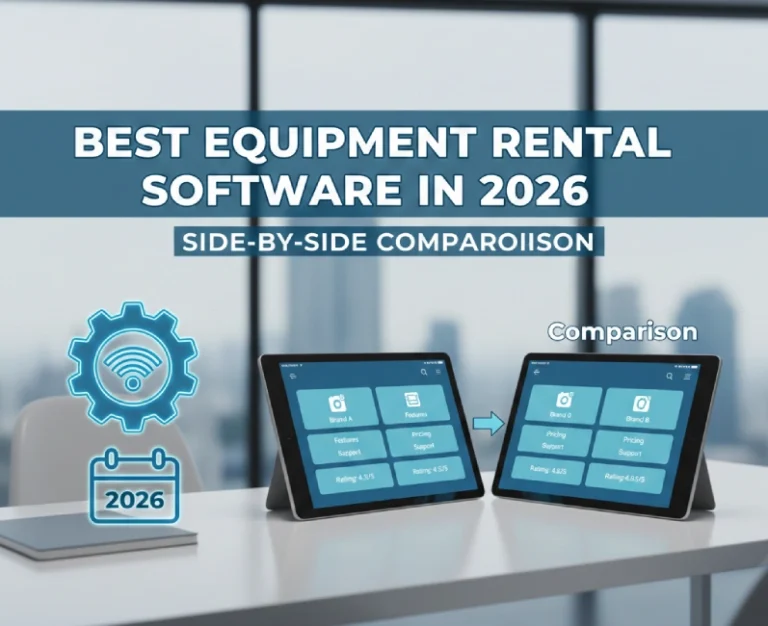
Comparison Table (2026 Edition)
| Feature | integraRental | Point-of-Sale Systems | Basic Inventory Tools |
| Core Focus | Scalable Rental Workflows | Retail Transactions | Stock Levels |
| Accounting | Deep QuickBooks Integration | Basic Export | None |
| Mobile Access | Full-Function Mobile App | Limited | Varies |
| Asset View | 28-Day Real-Time View | Daily/List Only | List Only |
| Support | Personal Relationship Focused | Ticket-Based | Community/Self-Serve |
Features
Top-tier platforms in 2026 offer cross-platform accessibility, allowing staff to manage the business from a desk or the yard. Key features include integrated credit card processing, GPS telematics for fleet tracking, and a fully digital eRental storefront for online reservations.
Pricing
Most providers utilize subscription-based models with tiers such as Base, Premium, and Enterprise to accommodate different business sizes. While baseline features handle core rentals, advanced capabilities like market rate analytics or extensive GPS tracking are often available as premium add-ons.
Ease of use
Modern software is designed to be intuitive, requiring minimal training for new staff. The best platforms use clear dashboards, such as a 28-day asset view, to help users quickly understand their inventory status.
Support options
Support ranges from automated help centers to dedicated account managers. Leading vendors prioritize building long-term relationships, offering personalized assistance to ensure the software matches the specific needs of the business.
Platform 1 – Deep Breakdown: integraRental
Strengths
The primary strength of integraRental is its deep, real-time integration with QuickBooks Online and Desktop, which eliminates the need for double data entry. It offers a specialized 28-day rental asset view that provides superior visibility across multiple locations. Additionally, the company has a long history of stability, having helped businesses since 1972.
Weaknesses
Advanced analytical tools, such as Rouse Analytics for market rate benchmarking, and GPS tracking features are premium add-ons rather than baseline features.
Best for
This platform is the ideal choice for businesses that want a powerful, cloud-based system that focuses purely on rental workflows. It is software companies will never outgrow because it can be scaled, for example, transitioning from a QuickBooks system to an integraERP system.
Platform 2 – Retail-Focused Systems
These systems are built for high-volume transactions but often lack the deep logic required for long-term rentals. They are strong in credit card processing and simple inventory but struggle with complex maintenance scheduling or meter-based billing.
Platform 3 – Legacy ERP Solutions
Legacy systems offer vast feature sets but can be difficult to learn and expensive to maintain. They often require significant on-site hardware and lack the flexibility of modern cloud-based mobile apps.
Platform 4 – Manual and Spreadsheet Methods
While essentially free, these methods carry the highest risk of human error. They provide no real-time visibility and become a major hurdle as soon as a business grows beyond a few dozen assets.
Category Winners
Best for small rental shops
integraRental is the winner here due to its “Base” tier which provides professional-grade tools like QuickBooks integration and mobile functionality at a scale that fits smaller operations.
Best for mid-size operators
For growing companies, the ability to manage multiple locations and track complex dispatch routes makes integraRental a standout choice.
Best for enterprise
Large operations benefit from the “Enterprise” tier and the option to integrate with more complex accounting solutions, like integraERP, while still maintaining simple rental processes.
Best value for money
Systems that offer a “Better Together” approach with existing accounting software provide the most value by reducing administrative labor costs.
Expert Recommendations Based on Use Cases
Contractor rental
Look for systems that include robust dispatch management and the ability to capture digital signatures and equipment photos in the field.
Tool rental
Priority should be given to ease of use at the front counter and fast check-in/check-out processes to handle high customer volume.
Party/event rental
Choose a platform that offers an eRental online store so customers can browse inventory and request reservations directly from your website.
AV rental
Precise tracking is vital for expensive electronics. Features like barcode scanning and serial number tracking are essential to prevent asset loss.
Final Decision Checklist
Does the software integrate with my current accounting platform?
Can my team use the software on mobile devices in the yard?
Is there a real-time view of asset availability?
Does the vendor have a proven track record in the rental industry?
Can the system grow with my business as I add more locations?