The rental industry is moving faster than ever before. Whether you are renting out heavy yellow iron or specialized event gear, the speed of your operations determines your profit margins. Many business owners focus entirely on the physical side of the house like fleet maintenance and yard logistics. While those are vital, the actual “heart” of your business is your financial data.
In a modern rental environment, having your inventory talk to your bank account is no longer a luxury. It is a fundamental requirement for survival. When your rental transactions flow directly into your accounting suite, you gain a level of clarity that manual spreadsheets can never provide. This integration creates a bridge between your operational reality and your financial health. It allows you to see exactly which assets are making money and which ones are simply taking up space in the yard.
The Hidden Costs of Manual Entry in Equipment Rental Management
Many small businesses start by using one system to manage their rentals and another separate system for their bookkeeping. At first, this seems manageable. However, as your fleet grows, the gap between these two systems becomes a financial black hole. Disconnected systems force your staff into a cycle of “double entry” errors. This happens when a team member creates a contract in your rental portal and then has to manually type that same data into an accounting program.
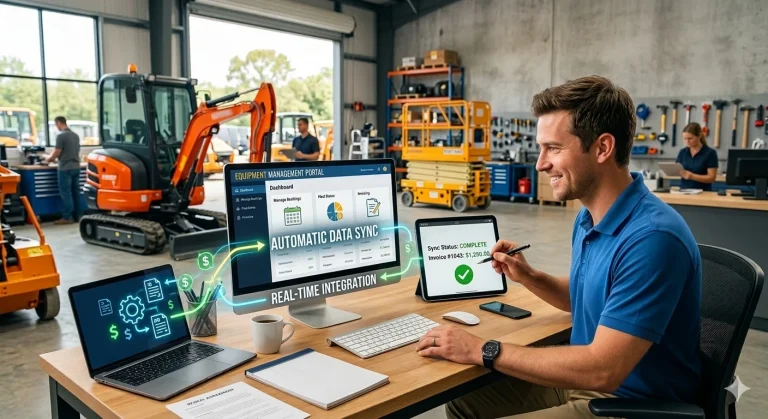
Every minute spent re-keying data is a minute stolen from customer service or business development. Beyond the lost time, manual entry is prone to human error. A misplaced decimal point or a forgotten invoice can lead to thousands of dollars in “leakage” over a single quarter. Finding software for the modern rental business means looking for a solution that eliminates these silos. For those looking for equipment rental software for small business, the goal should always be a “single source of truth” where a contract signed in the field instantly appears as a pending invoice in the office.
Mastering QuickBooks for Rental Business Success
QuickBooks is the gold standard for small to mid-sized business accounting. Yet, the rental industry has unique requirements that standard accounting setups struggle to handle. Rental businesses deal with security deposits, tiered pricing, and complex insurance waivers. If your rental equipment software QuickBooks workflow is not optimized, your books will quickly become a mess of unapplied credits and confusing journal entries.
True quickbooks rental management requires a specialized integration that understands the “rental life cycle.” This means when an asset is checked out, the software should automatically track the revenue recognition and any associated taxes. Effective quickbooks for rental business setups allow you to automate your accounts receivable. Instead of chasing payments, your system sends reminders and processes credit cards automatically. By using quickbooks for equipment rentals correctly, you transform your accounting from a “history book” into a real-time management dashboard.
Moving Beyond Accounting: Transitioning to an Equipment Rental ERP
There comes a point where a basic inventory tracker is simply not enough. As you scale to multiple locations or manage hundreds of high-value assets, you need an equipment rental ERP (Enterprise Resource Planning) system. A standard tracker tells you where a machine is located. An ERP tells you how much that machine has cost you in repairs versus how much it has earned in its lifetime.
Searching for the best erp software for equipment rental involves finding a platform that handles everything from procurement and maintenance to sales and disposal. An equipment rental erp integrates every department of your company into one interface. This bird’s-eye view is why the best equipment rental software erp options are so highly valued by growing companies. You stop guessing about your fleet’s performance and start making decisions based on hard data. This transition is what separates the companies that stay small from the ones that dominate their local markets.
Key Features of High-Performance Rental Inventory Management Software
What makes a high-performance system stand out? It usually comes down to how much “grunt work” the software handles for you. Rental inventory management software should do more than just count items. It should offer automated invoicing that triggers the moment a rental ends. It should also handle the heavy lifting of tax compliance, which is notoriously difficult in the rental world where tax rates can change based on the job site location.
An equipment rental quickbooks sync should be bi-directional. This means if you update a customer’s address in your accounting software, it should automatically update in your rental portal. High-performance tools also offer automated financial reporting. Imagine waking up on Monday morning and having a “Revenue by Asset” report already waiting in your inbox. This level of automation ensures that your team stays focused on moving equipment rather than shuffling paper.
Case Study: ROI of Integrated Financials
Consider a mid-sized equipment dealer that recently moved from manual tracking to an integrated system. Before the switch, they spent approximately 15 hours per week on manual data entry and invoice reconciliation. Their “unbilled revenue” was hovering around 4% due to lost paperwork and forgotten add-on charges like fuel and damage waivers.
After implementing a rental business case study model for integration, they eliminated those 15 hours of administrative work entirely. More importantly, their unbilled revenue dropped to nearly zero because the system wouldn’t allow a contract to be closed without addressing the fuel and cleaning fees. The ROI was clear. The software paid for itself within the first four months just by capturing revenue that was previously slipping through the cracks. This is the power of a modern, integrated rental ecosystem.
Frequently Asked Questions (FAQ)
1. Why is a QuickBooks integration better than using two separate systems for rentals and accounting?
Using a single integrated system eliminates “double entry” which is the primary cause of financial errors in the rental industry. It ensures that your bank balances always match your rental contracts in real-time. This saves hours of administrative work every week and gives you an accurate view of your cash flow without waiting for month-end reports.
2. What does an Equipment Rental ERP do that basic tracking software cannot?
While basic software tracks location and availability, an ERP manages the entire lifecycle of an asset. This includes tracking detailed maintenance costs, depreciation, and total lifetime profitability. An ERP connects your service department, your sales team, and your accounting office so everyone is working with the same data.
3. Can integrated rental software help with tax compliance for different job sites?
Yes, high-performance rental software can automatically calculate different tax rates based on the specific location where the equipment is being used. This is vital for businesses that operate across city or state lines where “use tax” and local sales tax rules can vary significantly.
4. Is it difficult to switch from manual spreadsheets to an integrated software solution?
While every transition requires some effort, modern cloud-based systems are designed for easy data import. Most providers offer onboarding services to help you move your inventory list and customer data into the new system. The long-term time savings usually far outweigh the initial setup period.
5. How does automated invoicing improve customer satisfaction?
Customers appreciate clarity and speed. Automated invoicing ensures that clients receive their receipts immediately after returning equipment. It also reduces disputes because the invoices are generated directly from the signed contract. This transparency builds trust and makes it easier for your customers to do business with you again.